Transposition of Chords: Instantly Play in Any Key
Learn the transposition of chords and instantly play in any key with confidence. Simple tips help guitarists adapt songs fast and improve musical flexibility.
magicchords.com
1/29/2026
The transposition of chords allows musicians to instantly play songs in any key, making it easier to match vocal ranges, explore creativity, and adapt music effortlessly while improving overall understanding of harmony and song structure.
The transposition of chords is one of the most powerful skills a musician can learn, yet it’s often overlooked by beginners and even intermediate players. If you’ve ever struggled to sing a song because it’s in the wrong key, or felt stuck playing the same chord shapes over and over, this concept can completely change how you approach music. Understanding how chords move between keys gives you freedom, flexibility, and confidence on your instrument.
At its core, transposition is about shifting a song into a different key while keeping its structure and emotional feel intact. Once you understand the logic behind chord relationships, you no longer depend on capo positions, memorized tabs, or fixed key signatures. The transposition of chords allows you to adapt instantly—whether you’re playing with other musicians, accompanying a singer, or experimenting with new sounds.
This skill is especially valuable for guitarists and keyboard players who want to play more intuitively. Instead of thinking in isolated chord shapes, you begin to recognize patterns, intervals, and progressions that work in every key. That means faster learning, better improvisation, and smoother transitions between songs. Over time, transposition trains your ear, strengthens your musical awareness, and makes complex music feel far more approachable.
In practical terms, mastering transposition helps you communicate better with other musicians. When someone says, “Let’s take this up a whole step,” you’ll know exactly what to do without hesitation. You’ll also gain the confidence to adjust songs on the fly during rehearsals or live performances. The transposition of chords turns rigid playing into a dynamic, responsive skill set.
In this guide, you’ll learn how transposition works, why it matters, and how to apply it easily in real musical situations. Whether you’re a beginner aiming to understand music theory or an experienced player wanting more control, this is a foundational technique that unlocks true musical freedom.
Useful advices for beginner guitar players 1: Learning guitar theory helps players unlock freedom across the fretboard with confidence and creativity. Early practice focuses on rhythm, timing, and understanding how chords relate to each other musically. In many lessons, the E major chord appears as a foundation, and from there the transposition of chords becomes easier to understand and apply. This knowledge allows musicians to change keys smoothly without relearning entire songs. With consistent practice, ears improve, hands relax, and musical choices expand naturally. Over time, theory and technique connect, empowering guitarists to adapt quickly, support singers, and perform comfortably in any musical situation with confidence always.
Transposition of Chords: Play in Any Key
Learning how to transpose guitar chords is very important and will help you a lot. Have you ever tried to sing a song but the guitar chords were too high for you and you failed? Well, if a song is too high pitched for your voice, these guitar chords should be transposed down a few steps. How to do it? It's not too hard to do, but you need to know a little bit of the theory behind it.
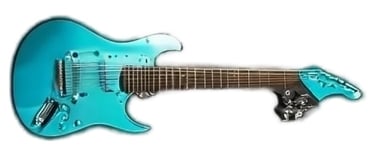
The term transposition of chords simply refers to changing the key of a song. You can also transpose a song to a lower or higher pitch. Transposing means that all the guitar chords change to a new pitch together. The main reason musicians transpose a piece of music is to accommodate the singer's range.
The easiest way to transpose is if you have a list of all the notes of the major scale in front of you. Let's say you have a chord progression of D major, G, and A major chords in the key of D, and you want to transpose it (you want to change those guitar chords in the song). Remember that picture of the notes (the one showing the order of the notes)? We'll need this now, so here it is:


So we have the D, G and A chord progression. You can also transpose this to a lower or higher pitch. Let's say you want to transpose from the key of D to the key of E. Now look at the picture above! E is a whole step (two half steps) higher from D. So the D chord becomes E major. This rule also applies to other guitar chords. This means you have to go up two steps for each one. G chord becomes A, A becomes B major guitar chord. If you want to go down five steps (half steps), D becomes A, G becomes D, and A becomes E major. Just look at the chart and do the math.
Let see an example: I’ve been working on the railroad. The guitar chords are D, G, E and A major guitar chords:
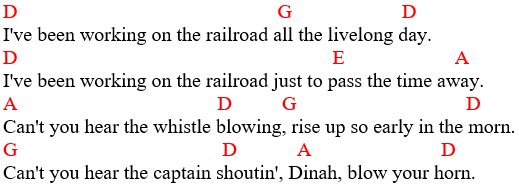
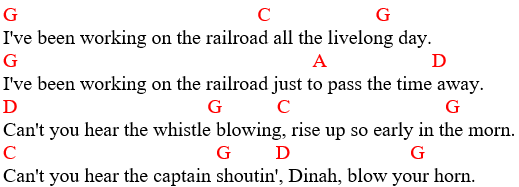
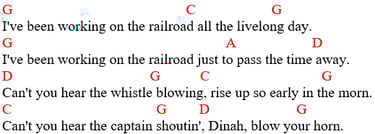
Now we transpose the song five steps up. Look again the chart above and count the guitar chords: First the D major: 1 step – D#; 2 steps – E; 3 steps – F; 4 steps – F# and 5 steps – G. So D becomes G. The G major: 1: G#; 2 – A; 3 – A#; 4 – B; 4 – C. G becomes C. The E chord: 1 – F; 2 – F#; 3 – G; 4 – G# and 5 – A. E becomes A. The A chord: 1 – A#; 2 – B; 3 – C; 4 – C# and 5 – D. A becomes a D major guitar chord.
So our song with the new transposed chords gonna look like that:
The guitar is a magnificent instrument of patterns and shapes. Unlike the piano, where moving a song from C major to D major requires learning an entirely new set of black and white keys, the guitar allows for a more geometric approach to music. This unique characteristic makes transposition of chords one of the most powerful skills a musician can possess. Whether you are trying to match a singer’s vocal range, simplify a complex chord progression, or change the emotional color of a piece, understanding how to shift keys fluidly is what separates a beginner from a versatile performer. In this comprehensive guide, we will explore the art and science of transposition of chords, moving from the basic mechanics to the high-level mental frameworks used by professionals.
The Core Principles of Transposition of Chords
To master transposition of chords, one must first understand what transposition actually is: the process of moving a collection of notes or chords up or down in pitch by a constant interval. Imagine a ladder where each rung represents a semi-tone. When you transpose, you are simply taking the entire song and moving it three rungs up or two rungs down. The relationship between the notes—the melody and the harmony—remains identical, but the overall "altitude" of the sound changes. This is vital for vocalists who may find a song’s original key sits right on their "break," making it difficult to sing. By lowering or raising the key, the guitarist can place the melody in the singer's "sweet spot."
On the guitar, this process is facilitated by the instrument’s linear nature. Because the fretboard is divided into half-steps (each fret), the physical distance of a whole step or a half step remains consistent regardless of where you are on the neck. This geometric symmetry is the secret weapon of the guitarist. However, the challenge arises when we deal with open strings. To truly excel at transposition of chords, a player must learn to bridge the gap between the "open" world of cowboy chords and the "closed" world of movable shapes. This transition is where the real magic happens, allowing a player to take a song written in a difficult key like E-flat major and play it with the same ease as a song in C major.
Using the Capo for Quick Transposition of Chords
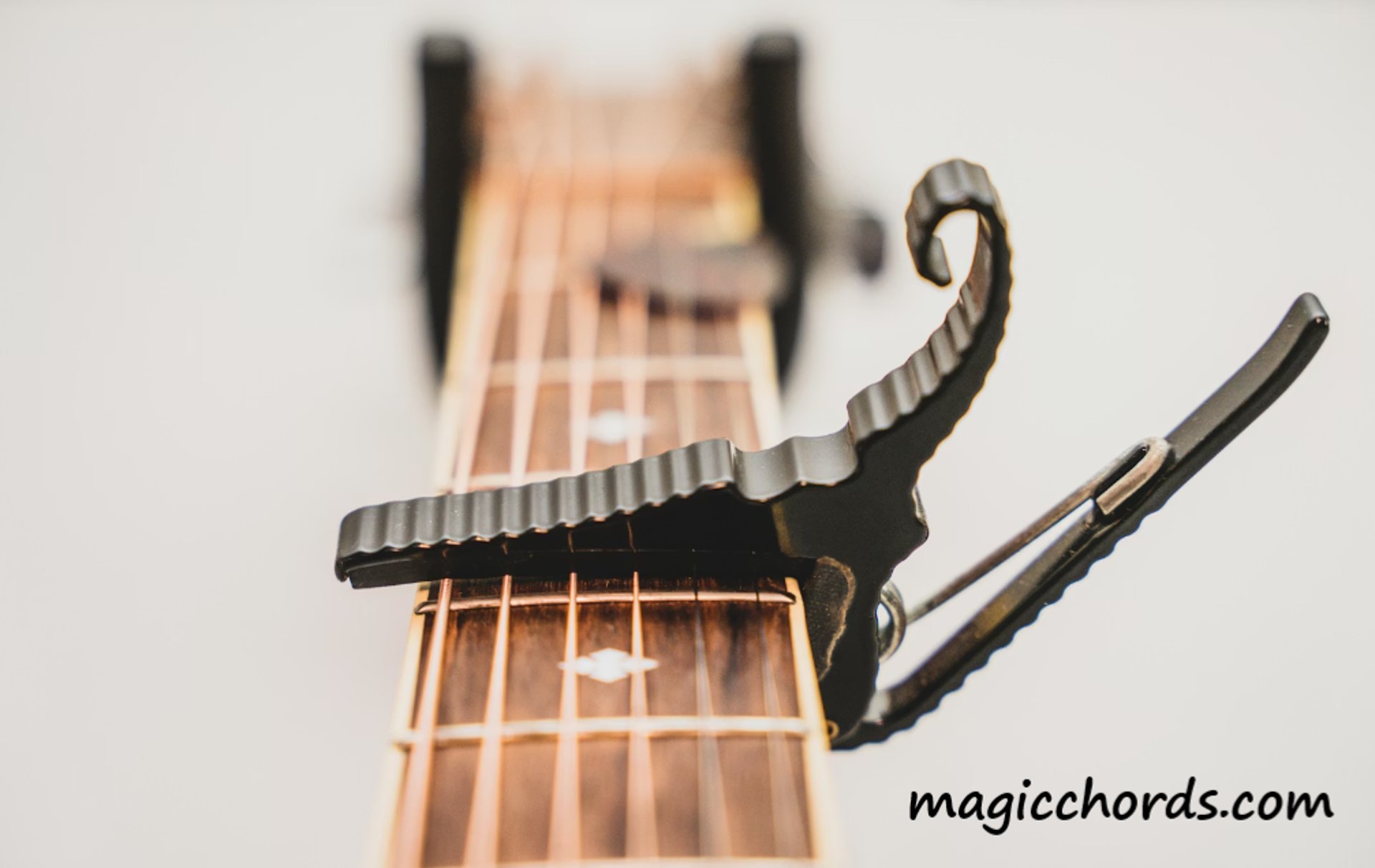
For many guitarists, the first encounter with transposition of chords comes in the form of a small, spring-loaded device called a capo. The capo serves as a moveable nut, effectively shortening the scale length of the guitar and raising its pitch. It is perhaps the most practical tool for rapid transposition because it allows you to keep using the chord shapes you already know while sounding in a different key. For example, if you place a capo on the second fret and play a standard C major chord shape, the guitar will actually ring out a D major chord. This is a game-changer for singer-songwriters who want to maintain the specific "ring" and resonance of open-string chords while adapting to their vocal needs.
However, using a capo is not just about making things easier; it is a sophisticated method of transposition of chords that preserves the "voicing" of a piece. Certain songs rely on the specific relationship between open strings and fretted notes—think of the iconic intro to "Hotel California" or the folk stylings of Simon & Garfunkel. By moving the capo, you can preserve those intricate fingerpicking patterns while shifting the key. The key to mastering the capo is learning the "CAGED" system logic: knowing that a G-shape played with a capo on the 5th fret is actually a C major chord. This mental mapping ensures that you aren't just blindly moving a clamp, but rather making an informed musical choice.
Manual Transposition of Chords: Movable Shapes
While the capo is a fantastic tool, true mastery of transposition of chords requires the ability to transpose without external aids. This is achieved through the use of movable shapes, most notably barre chords. In this scenario, your index finger acts as a "human capo." The beauty of the guitar lies in the fact that once you learn an E-major barre chord shape, you have effectively learned every major chord on the fretboard. By simply sliding that static shape up and down the E-string, you are performing a physical act of transposition. This method is essential for genres like jazz, funk, and blues, where quick key changes are common and the use of a capo might be impractical or stylistically out of place.
To internalize transposition of chords through barre chords, one must become intimately familiar with the notes on the E and A strings. These strings serve as the "anchor" for most movable shapes. If you know that the 8th fret of the E-string is a C, and you know your major and minor barre chord shapes, you can instantly play a song in C major anywhere on the neck. This skill also opens the door to "linear transposition," where you can move entire lead lines or riffs up and down the neck. If a blues riff works in A (5th fret), moving it up to the 7th fret instantly transposes it to B. This visual and tactile approach to music is what makes the guitar such an intuitive instrument for transposition once the initial finger strength is developed.
Theory and The Number System for Transposition of Chords
Beyond the physical movements on the fretboard, the highest level of transposition of chords involves a mental shift in how we perceive music theory. Professional session musicians often use the Nashville Number System, which replaces chord names with numbers based on their scale degree. In this system, a standard progression like G - C - D is not thought of by its letters, but as a 1 - 4 - 5 progression in the key of G. When the band leader says, "Let's do this in A," the guitarist doesn't have to scramble to remember new chords. They simply apply the 1 - 4 - 5 logic to the new key: A - D - E.
This analytical approach to transposition of chords removes the guesswork. It requires a basic understanding of the diatonic scale—the idea that every key has a set of seven predictable chords. By thinking in numbers, you are transposing the "function" of the chords rather than the notes themselves. This is particularly useful when dealing with "outside" chords or accidental flats and sharps. If a song in C major has a Bb major chord (a "flat-seven"), and you transpose the song to G major, you immediately know you need an F major chord (the "flat-seven" of G). This level of fluency allows you to follow any singer or soloist into any key on the fly, a hallmark of a professional musician.
Daily Exercises to Master Transposition of Chords
Becoming proficient at transposition of chords is not something that happens overnight; it requires deliberate practice and ear training. A highly effective exercise is to take a simple nursery rhyme or a basic three-chord pop song and attempt to play it in all twelve keys. Start with the "guitar-friendly" keys like G, C, D, A, and E. Then, push yourself into the "difficult" keys like Ab, F#, or Db. This forces you to confront the areas of the fretboard you usually avoid and builds a robust mental map of the instrument. Over time, the "static" between your brain and your fingers will disappear, and transposition will become as natural as breathing.
The transposition of chords is the ultimate bridge between technical skill and musical expression. It frees you from the constraints of the printed page and allows you to adapt to the needs of the moment. By combining the physical convenience of the capo, the structural logic of barre chords, and the theoretical depth of the number system, you transform the guitar from a box of fixed sounds into a limitless tool for creativity. Whether you are jamming in a garage or performing on a world stage, the ability to play in any key ensures that you are always ready for the music, wherever it may lead.

Useful advices for beginner guitar players 2: Learning guitar often begins with basic exercises and simple chord progressions that build strength and coordination. As players gain confidence, they start exploring iconic songs that inspire deeper practice and emotional expression. Somewhere in the middle of this process, many guitarists search for the Metallica – Nothing Else Matters guitar tab to improve fingerpicking technique and musical sensitivity. Working through such a song helps develop timing, control, and patience. With regular practice, difficult passages become familiar, mistakes fade, and the music starts to feel natural and expressive over time.